As an Amazon Associate, we earn from qualifying purchases. Some links on this site are affiliate links at no extra cost to you. Our recommendations are based on thorough research and editorial judgment.


What LiPo Voltage Do Luxury RC Cars Support?

Luxury RC cars typically support several LiPo voltage configurations, mainly 2S (7.4V), 3S (11.1V), and 4S (14.8V). Each configuration suits different performance needs. For instance, a 2S is great for beginners, while a 4S packs a serious punch for racing enthusiasts seeking speed. It’s vital to match your ESC and motor with the chosen voltage to prevent damage. Interested in how these voltages affect performance and safety? Let’s explore that further.
Key Takeaways
- Luxury RC cars typically support various LiPo configurations, including 2S (7.4V), 3S (11.1V), and 4S (14.8V) based on performance needs.
- The choice of voltage impacts speed, acceleration, and overall performance tailored to the driver’s style.
- 2S is suitable for beginners and casual driving, while 3S balances power and safety for moderate racing.
- For maximum performance, 4S is preferred by racing enthusiasts, but requires compatible motors and ESCs to avoid damage.
- Always ensure proper charging equipment and practices are followed for the selected LiPo voltage to ensure safety and battery longevity.
Understanding LiPo Cell Voltage Basics
You may be interested


Understanding the basics of LiPo cell voltage is essential for anyone looking to get the most out of their luxury RC cars. Let’s break it down:
- Nominal Voltage: Each LiPo cell has a nominal voltage of 3.7 volts, representing average charge.
- Maximum Voltage: The absolute limit is 4.2 volts per cell. Exceeding this risks severe damage.
- Discharge Voltage: Ideally, we shouldn’t drop below 3.0 volts per cell to avoid critical failure.
- Storage Voltage: Best storage is around 3.75 to 3.85 volts, preserving battery health during inactivity.
- Charging Dynamics: Understanding how voltage rises during charging helps maintain charge efficiency.
- Advanced battery management systems high-performance models can provide features such as low voltage protection and temperature monitoring, enhancing safety and longevity.
Typical Voltage Configurations for Luxury RC Cars

When it comes to luxury RC cars, the choice of LiPo battery configuration plays a significant role in how our models perform. Most of us opt for 2S (7.4V) to 4S (14.8V) packs, offering varying strengths and suitability.
- 2S battery advantages: Lightweight, great for agility.
- 3S performance balance: A popular choice, providing speed with safety.
- 4S racing capabilities: Ideal for maximum power and speed bursts.
While comparing voltage configurations, remember the importance of LiPo size considerations and discharge rate impact. We also need to be aware of ESC compatibility issues. Too much voltage can lead to overheating! Additionally, considering terrain compatibility is crucial for optimizing performance across different surfaces. Keeping voltage levels clarified guarantees our setups run smoothly and perform well.
Recommended Products

【Officially Licensed Ford Bronco Baja 1000 Design】Fully licensed by Ford and RTR Vehicles, featuring two iconic Baja 1000 liveries from 2024 and 2025—perfect for collectors and hardcore off-road fans.
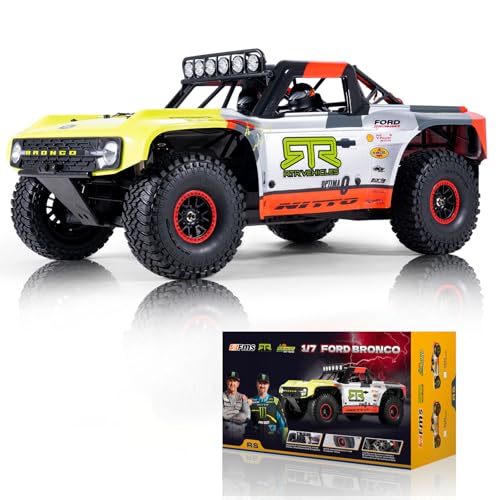
【Fms 1/7 Ford Bronco RTR EB Brushless RC】Officially Licensed by Ford and RTR Vehicles, this model is based on the Ford Mustang racing car that competes in the Ultra4 event. It combines RTR design concepts with cutting-edge racing technology to perfectly reproduce the ultimate driving pleasure of racing on a 1/7 scale platform.

Officially Licensed by Ford and RTR Vehicles, True Off-Road Spirit: The Ford Bronco RTR EB is officially licensed by Ford and RTR Vehicles, faithfully recreating the bold design and spirit of full-size off-road racers. With its rugged construction and aggressive styling, it gives you the feeling of driving a real off-road vehicle, built specifically for extreme terrains like desert tracks and rocky trails, so can enjoy an authentic off-road adventure anytime.
The Impact of Voltage on Performance

Voltage plays an essential role in the performance of luxury RC cars, impacting everything from speed to handling. When we increase the LiPo voltage, we see significant improvements:
- Speed & Acceleration: Higher voltage, like moving from 2S to 3S, boosts top speed and allows for quicker acceleration due to better motor response.
- Motor Compatibility: It’s vital to confirm our motors and ESCs are rated for these voltage increases to avoid damage.
However, we must consider voltage efficiency. While higher voltage packs can deliver more power, they can also shorten runtime due to increased energy consumption. Balancing performance and battery life is essential. By carefully tuning our setups, we can maximize the benefits while maintaining reliability and control in our luxury RC cars. Additionally, the choice of a high-performance brushless motor can further enhance speed and torque, providing an even greater edge in performance.
Recommended Products

【Zeee 6S 9000mAh RC Lipos Specification】- Battery voltage: 22.2V; Configuration: 6S1P; Cell voltage: 3.2~4.2V; Capacity: 9000mAh; Discharge: 100C; Connector type: EC5 Plug.

【Yowoo 4S Lipo Battery 10000mAh Specification】- Capacity: 10000mAh; Voltage: 14.8V; Cell: 4S; Cell voltage: 3.7~4.2V; Discharge: 150C; Discharge plug: QS8 Connector; Dimension: 167 x 51 x 41.5 mm (±5mm difference) / 6.57 x 2.00 x 1.63 inch; Approx Weight: 750g(±10g) /1.65 lb / 26.45 oz.

【Zeee 4S 10000mAh Lipo Specification】- Battery voltage: 14.8V; Capacity: 10000mAh; Discharge: 120C; Configuration: 4S1P; Cell voltage: 3.2~4.2V; Plug: EC5 Connector.
Safety and Handling of High Voltage LiPo Packs

While exploring the thrill of high-performance luxury RC cars, we can’t overlook the safety aspects of high voltage LiPo packs. Here’s what we must keep in mind:
- Charging Precautions: Always use compatible chargers and practice balance charging to prevent overvoltage. Charge in fireproof containers and never leave batteries unattended.
- Battery Maintenance: Store packs at 3.7-3.85V per cell to minimize risks. Handle them gently to avoid punctures, and disconnect them from devices when not in use.
Monitoring swelling or deformation is essential—address these warning signs immediately. Regularly inspect connectors and wiring, ensuring they’re rated for high voltage. Additionally, the durability and build quality of your RC car plays a crucial role in battery performance and safety. By following these guidelines, we can enjoy our RC car experiences safely while keeping high voltage LiPo packs under control.
Choosing the Right Voltage for Your Driving Style

Choosing the right voltage for our RC cars can greatly enhance our driving experience. When we consider voltage compatibility, it’s vital to match our battery selection with our driving preferences. For casual driving, a 2S pack (around 7.4V) is typically sufficient, providing a balanced speed with minimal risk.
For those seeking higher performance, 3S packs (11.1V) offer more power and speed, ideal for racing. However, we must verify our ESC and motor can handle this increased voltage to avoid damage.
Here’s a quick guide:
- 2S (7.4V): Recommended for beginners and casual driving.
- 3S (11.1V): For bashing and moderate racing.
- 4S (14.8V): Best for racing enthusiasts wanting extreme performance.
Additionally, considering factors like motor power and speed will further help optimize our racing capabilities. Performance tuning starts with knowing which voltage suits our driving style!
Recommended Products

Delivers 2x100W of charging power

Battery Type: Lithium Polymer (LiPo)

FOR USA CUSTOMERS ONLY!! International Orders Will Be Canceled! THIS BATTERY CANNOT BE SHIPPED INTERNATIONALLY DUE TO AIR TRANSPORT RESTRICTIONS Incorrect use of battery can result in battery failure, explosion and fire! Dollar Hobbyz is not responsible for any Damage or Harm done by using this battery Please use a LiPo Charger with a built in balancer Due to the nature of LiPo batteries, this battery carries NO WARRANTY If you have never used LiPo batteries before, please c
Frequently Asked Questions
Can I Use Higher Voltage Batteries in Lower Voltage RC Cars?
We can’t use higher voltage batteries in lower voltage RC cars. LiPo compatibility concerns arise, leading to voltage mismatch effects that risk overheating and damage to motors and ESCs, ultimately compromising performance and safety.
What Happens if I Overcharge a Lipo Battery?
When it comes to battery safety, we’ve got to be careful. Overcharging effects include chemical damage and increased fire risk. Let’s keep our LiPo batteries in check to avoid serious issues down the line.
How Do I Determine My Esc’s Voltage Rating?
To determine our ESC’s voltage rating, we should check the ESC specifications, examining markings on the case and referring to the manual. This guarantees we comprehend voltage compatibility for safe and ideal performance.
Are There Risks With Using Old Lipo Batteries?
Using old LiPo batteries is like sailing a ship with frayed sails; we expose ourselves to risks of performance decline and battery lifespan issues. Chemical degradation can lead to dangerous failures we shouldn’t take lightly.
How Often Should I Recharge My Lipo Batteries?
We should recharge our LiPo batteries after each use to optimize charging frequency and battery lifespan. Keeping them above 3.7V per cell guarantees they remain healthy and ready for our next adventure.